


»Mastering Transformation: 4 Key Perspectives.«
Becoming a progressive competitor, being aware of environment and human needs.

Transformation invites leadership teams to become the best version of themselves.
Markets may shift, competitors may adapt fast, new technologies may evolve and organizations may grow by discovering new territories.
Yet, in every situation, as fuzzy as it might appear, leadership is expected to provide direction, drive progress and deliver results. This accounts especially for times of change where uncertainty can become a major concern.
These four perspectives do not provide ready-made answers. Instead they help leadership teams ask better questions (press buttons to explore) :
»
Familiar with the wide range of systemic consulting practices, we believe in the importance of four genuine perspectives, helping leadership to understand: why times of change are perfectly suited for becoming a progressive competitor; why awareness for environmental forces and human needs will boost competitiveness.
Why does progress gain force in some situations and stagnates in others?
Circle of Progression
Leadership teams usually know what they want to achieve and why it matters. Resources have been committed. People have been informed. Initiatives have been launched.
Yet some ambitions create acceleration and lasting progress while others never seem to move beyond recurring discussion and pure activism:
- Why do some strategies create progression while others remain trapped in endless discussions?
- Why do some transformations reinforce themselves while others require constant intervention?
- Why do some organizations create ownership while others continue pushing without real traction?
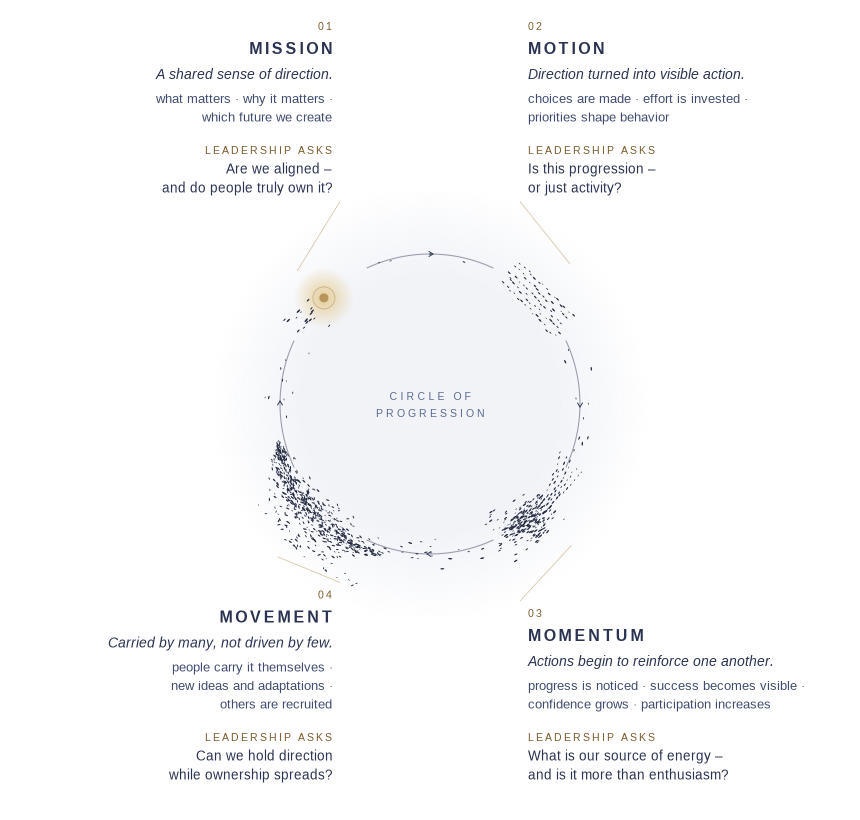
Most organizations perceive progression as a sequence of linear steps. In its simplest fashion leadership differentiates a plan, a build and a run phase.
These transitions can be described as turning
mission into motion, momentum and movement. Most importantly: these are not static stages. Organizations continuously oscillate between all four of them.
Progress requires movement. The greatest potential for accelerationlies within the transition between one State to the next.
» We prefer a circular perspective assuming that organizations operate as social systems and We believe in putting the human factor first: its people who interpret, resonate and respond..
We think the progress emerges through a series of reinforcing narratives and transitions.
Where progress typically breaks down
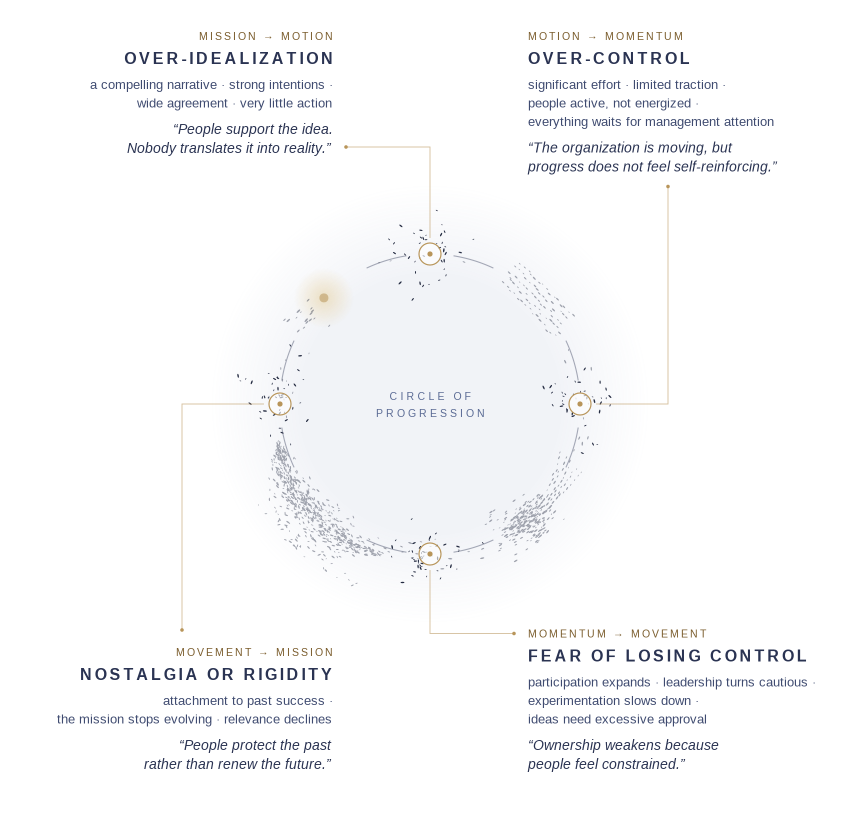
The Circle of Progression does not only highlight acceleration. It also reveals common risk patterns.
Why this perspective matters
Many leadership teams focus on strategy, structures, governance, initiatives. All of these matter.
Yet the "Circle of Progression" asks a different question: How does progress actually emerge?
Not in theory, nor in PowerPoint documents. But in real life.
This perspective helps leadership teams understand:
- Why some initiatives gain force and traction while others lose energy
- Why ownership sometimes spreads and sometimes does not
- Why organizations become trapped despite good intentions
- Why movements occasionally emerge where leaders least expect them
Most importantly, it helps leadership to distinguish between:
These distinctions determine whether an ambition
becomes a reality or remains an aspiration.
If you want to look at your leadership challenge in light of the "Circle of Progression" let's get in touch and have a conversation.

Progress alone is not enough.
The "Circle of Progression" helps leadership understand how direction becomes action, how action gains momentum and how movement may eventually become self-sustaining.
Yet another challenge inevitably evolves. Many organizations succeed in creating movement. Some succeed in sustaining it. Others gradually lose force despite good intentions, capable people and continuing effort.
» Progress helps explain movement. It does not explain HIGH-performance.
» Leadership must look beyond progress itself, examining enablers for sustained competitiveness.
What sustains competitive performance over time?
Success Factors for Competitive Edge
Organizations do not lose competitiveness overnight. Performance often remains acceptable long after deeper problems have started to emerge. Customers remain and revenues continue. People stay busy. The organization appears to be functioning.
Yet leadership teams gradually notice signs that something is changing:
This raises important leadership questions:
- Why do some organizations stay sustainably competitive while others gradually lack acceleration?
- What conditions allow organizations over long periods of time to deliver high-performance?
Why these questions matter? Leadership often focuses on visible outcomes: growth, profitability, market share, innovation, customer satisfaction. These indicators matter. But they are usually effects rather than causes.
The
Success Factors for Competitive Edge focus on five conditions that repeatedly influence an organization's ability to create and maintain the leavers for competitive edge.
» Organizations rarely struggle because one critical factor is entirely absent. They struggle because essential conditions gradually weaken at the same time.
»
Performance may remain stable for a period. Competitiveness does not.
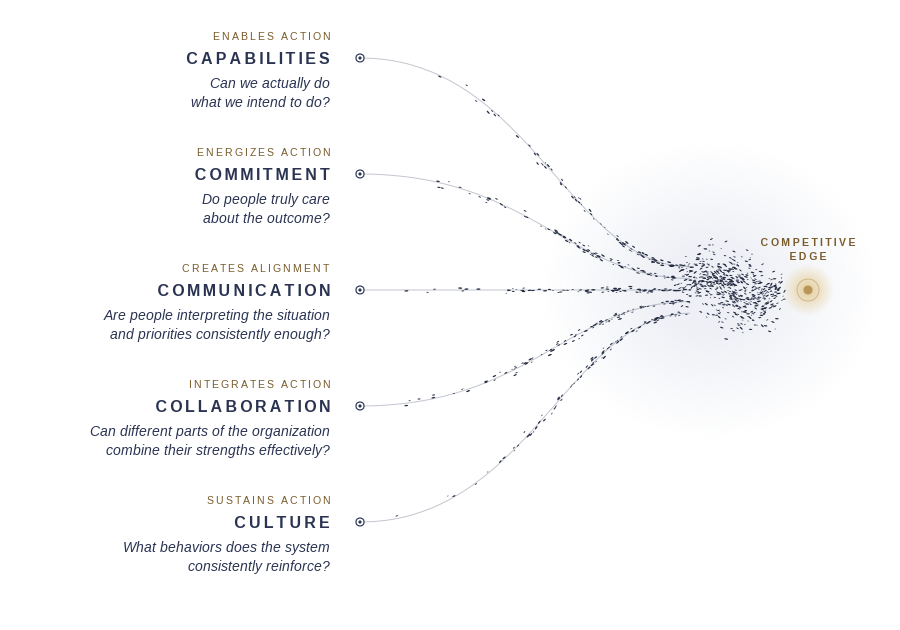
Where the ability to compete typically turns south.
The "Success Factors for Competitive Edge" also help leadership teams identify whether progress is slowing because:
» Capabilities may be inadequate.
Without the necessary knowledge, skills, systems and resources, even the most compelling ambition remains theoretical.
» Commitment may weaken.
Commitment emerges when people understand the direction, believe it matters and choose to subscribe and invest themselves in it.
» Communication might fragment.
Organizations often underestimate how quickly priorities become fragmented when communication loses clarity.
» Collaboration may become difficult.
Most organizational challenges evolve because of cross-functional, geographical and hierarchical boundaries. Those emerge usually because people rather see the losses than the gains.
» Culture may unintentionally work against the desired outcome.
Culture influences what people pay attention to, what they consider acceptable and how decisions are made when nobody is watching.
Finally this perspective helps leaders recognize that the success factors do not operate independently.
Competitive advantage emerges when they reinforce one another.
Decline often begins when they stop doing so.
Further questions for leadership teams:
- Which of the five factors currently represents our greatest constraint?
- Which factor do we tend to underestimate?
- Where are we compensating for weaknesses rather than addressing them?
- Which reinforcing conditions require attention today if we want to remain competitive tomorrow?
If you want to discuss your case with us, contact us and let's start with a conversation.

Strong organizations do not succeed on internal strength alone
Capabilities, commitment, communication, collaboration and culture help explain whether an organization can sustain performance over time. But internal strength is only part of the picture.
An organization may have capable people, committed teams and a healthy culture and still struggle to create progress:
What environmental forces support or hinder continued progression?
Environmental Forces
Leadership teams spend considerable time defining what the organization should achieve. Strategic direction. Business priorities. Growth ambitions. Transformation agendas.
But progress does not depend on intention alone. A mission may be compelling. Actions may have begun. People may be investing significant effort. And progress may still struggle to gain traction.
The reason may not lie in the mission or the level of effort. It may lie in the environment in which the mission is expected to hit the ground.
This raises a critical leadership question:
- What is enabling progress, and what is constraining it? Four aspects deserve particular attention:
» Leadership needs to grasp the external factors enabling progress and lasting competitiveness.
»
Critical dynamics in the environment require deep understanding and foresight.
Together, these questions help leadership teams understand why a compelling mission may resonate, stall, accelerate or lose force.
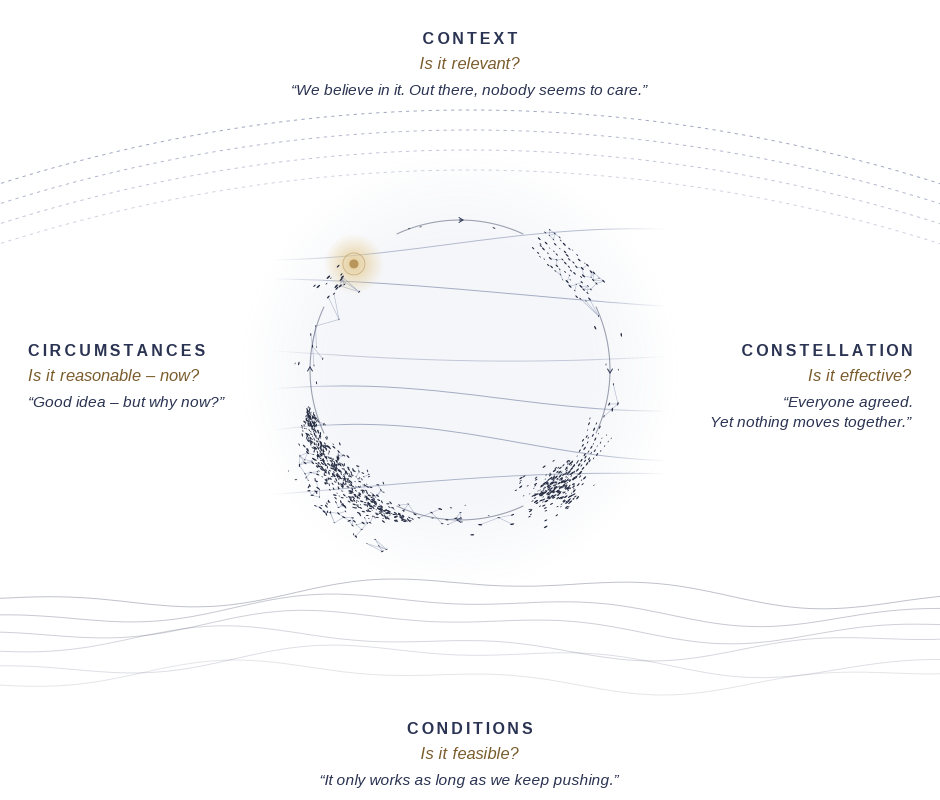
Encompasses the broader environmental space of a mission—including markets, industries, culture, history, and socio-technological shifts.
A strategy is relevant if it resonates with the existing demands, concerns, and aspirations of its environment.
» Contextual understanding aims at aligning the chosen direction with stakeholder interests.
Further questions for leadership teams:
- Why does this mission matter now?
- Which broader developments strengthen or weaken its relevance?
- What concerns, aspirations or tensions does it address?
- How will history, culture or industry shape its interpretation?
- Would people outside our organization consider it important?
Define the immediate environment where action begins. They encompass timing, triggers, constraints, opportunities, pressures, and readiness.
A mission can be highly relevant in principle, yet fail to spark motion if action feels unreasonable under current conditions. To move forward, people must understand not only why a direction matters, but why this specific response makes sense right now.
»
Leadership must distinguish an ambition from an action viable at a particular moment.
Further questions for leadership teams:
- Why should we act now?
- What has changed?
- Which opportunity or pressure creates urgency?
- Is our proposed response proportionate to the situation?
- Which immediate constraints must we acknowledge?
- How ready is the organization for the next step?
Define whether strategy execution succeeds or fails based on its foundations. Momentum requires more than a compelling mission or a capable team; without aligned resources, infrastructure, governance, and culture, even the best initiatives stall.
Turning intent into lasting performance requires three critical dimensions:
- Agency: Do people have the explicit authority, capabilities, time, and resources to act consistently?
- Alignment: Do structures and systems actively reinforce the new direction, or do they block it?
- Authenticity: Do cultural norms make the targeted behavior credible and self-sustaining?
» Understanding the enabling conditions helps to distinguish mere intent from actual feasibility.
» Feasibility emerges from the interaction of capability, authority, infrastructure, culture and identity.
Further questions for leadership teams:
- Do people have the capabilities and resources required to move forward?
- Do structures and systems support the chosen direction?
- Which rules or routines are unintentionally slowing progress?
- Does decision-making take place where the necessary knowledge exists?
- Which cultural norms reinforce the intended movement?
- Which established practices pull the organization back?
- Could progress continue without constant leadership pressure?
Defines the relational ecosystem required to drive sustainable momentum. It spans key actors, networks, alliances, trust, and underlying power dynamics.
Strategy alone does not guarantee execution. True momentum is born from alignment; the exact same initiative can yield radically different outcomes depending on stakeholder buy-in, resistance, and relationship dynamics. Even the most promising projects fail if critical alliances are missing or hidden tensions stall progress.
» Leadership needs to understand dependencies and power structures that formal org charts hide.
» Knowing whether stakeholder interactions accelerate or obstruct progress is of vivid importance.
Further questions for leadership teams:
- Who must contribute for this initiative to gain momentum?
- Whose trust, support or legitimacy is essential?
- Which relationships currently strengthen progress?
- Which tensions or competing interests weaken it?
- Who connects different parts of the system?
- Which important alliances are still missing?
- Does the current constellation allow different strengths to reinforce one another?
Each of the four dimensions points towards a different leadership challenge:
» Relevance problems cannot be solved by adding resources.
» Unreasonable responses cannot be repaired through more communication.
» Ineffective constellations cannot be corrected through governance alone.
» Infeasible movements cannot be sustained indefinitely through executive pressure.
Progress gains force when relevance, reasonableness,
effectiveness and feasibility reinforce one another.
If you want to discuss your case with us, contact us and let's start with a conversation.

People determine whether opportunities become reality.
Environmental Forces help leadership teams understand the conditions surrounding the organization. They reveal opportunities. They reveal constraints. They reveal changes that may strengthen or weaken strategic choices.
Yet no strategy succeeds on organization-specific success factors and environmental conditions alone. Every strategic priority, transformation, growth initiative and change effort ultimately depends on people. People interpret the situation and decide whether to subscribe and engage. People determine whether momentum grows or fades.
What needs make people respond differently to the same change?
Fundamental Human Needs
Many leadership teams eventually encounter the same puzzle. The same strategy is communicated. The same change is announced. The same message is delivered. Yet people respond very differently:
- Some become enthusiastic.
- Some become cautious.
- Some actively contribute.
- Others remain distant.
This raises a leadership question that sits at the heart of every transformation:
- Why do intelligent and committed people respond so differently to the same situation?
Why this matters?
Organizations do not change. People do. Strategies, messages and decisions are interpreted by different minds and most importantly by different emotions. The same event can be experienced differently depending on what people perceive to be at stake.
» We see change efforts struggle because of their primary focus on the logic and stream of events. People usually respond to something deeper: their experience of the change.
»Human Needs (according to psychiatrist Klaus Grawe: Neuropsychotherapie. Göttingen 2004). provides leadership with a lens for understanding the drivers of human behavior: Why consistency of minds and psychological safety are key, being not an ad on to change.
People seek
clarity.
They want to understand what is happening and how it affects them.
People want
to feel connected.
They want to know they remain part of something important.
People want to contribute meaningfully.
They want their effort, expertise and experience to matter.
People seek
physical, emotional
and economic
security.
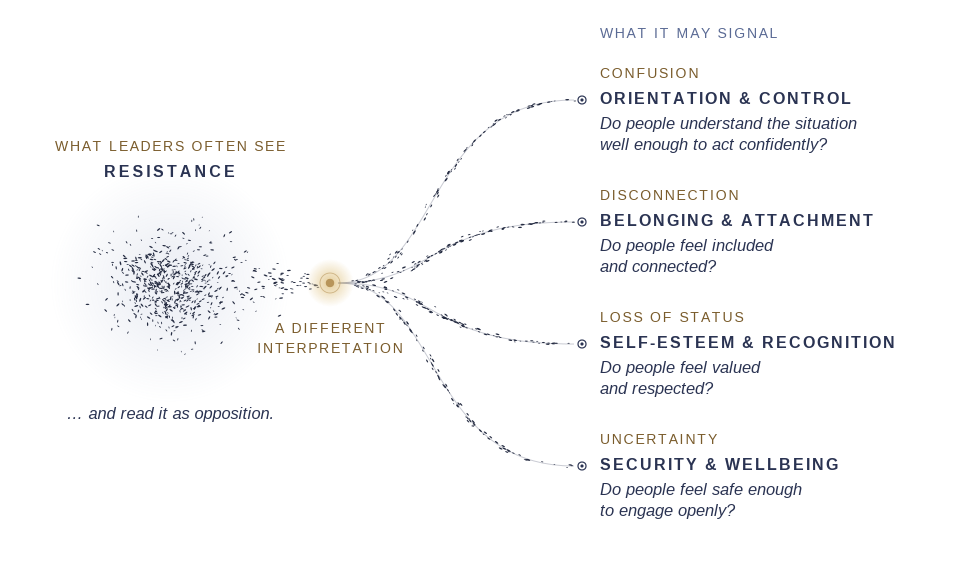
Leadership teams often interpret resistance as opposition. This perspective encourages a different interpretation:
» Resistance may signal: confusion, disconnect, loss of status, concerns about wellbeing.
» Understanding these signals will ensure that leadership engages with people more effectively.
Further questions for leadership teams:
- What experience are people currently having?
- Which needs are being strengthened?
- Which needs may be feeling threatened?
- What are people protecting?
- What would help them engage more confidently?
Seeing familiar situations through different lenses
Each of the four presented perspectives highlights a different aspect of organizational reality. They help leadership teams see aspects of reality that might otherwise remain invisible:
» "Circle of Progression" does explain how movement emerges.
» "Success Factors for Competitive Edge" explains how movement can be sustained.
» "Environmental Forces" explain why some initiatives gain traction while others struggle.
» "Fundamental Human Needs" explain when people choose to engage, contribute or withdraw.w
Sometimes these different perspectives may lead to a different question. Sometimes to a different interpretation. And sometimes to a different decision.
All four can change the trajectory of an organization.
See where progress is becoming vulnerable. Test what may be causing it. Decide where leadership attention matters most.
Transformation Navigator (TNAV) · Beta Edition
TNAV is an executive navigation tool for CEOs and leadership teams facing consequential strategic, leadership, transformation and Human-AI decisions. It helps to:
» examine one specific situation through four complementary perspectives.
» identify where strategic intent, capability and decision architecture may lack coherence.
Results are working hypotheses intended to challenge interpretation, focus leadership attention and identify evidence worth examining before consequential decisions are made.
TNAV is currently being field-tested with executives and leadership teams. It is not a maturity assessment and does not diagnose your organization.
Privacy: TNAV responses and results remain in your browser and are not submitted to mitomo. Beta feedback is voluntary and separate. Please do not include confidential company information, personal data, or information identifying other individuals in your feedback.
If you want to discuss your case with us, contact us and let's start with a conversation.