


»Direction is set. Do we turn it into motion?«
Translate strategic choices into business impact.

Turning strategy into distinct meaning.
Leadership sets direction by connecting long-term ambition with the tactical choices, priorities and decisions required in the present.
Strategic priorities may have been translated into targets, resources committed, progress may be monitored through scorecards and business reviews.
»
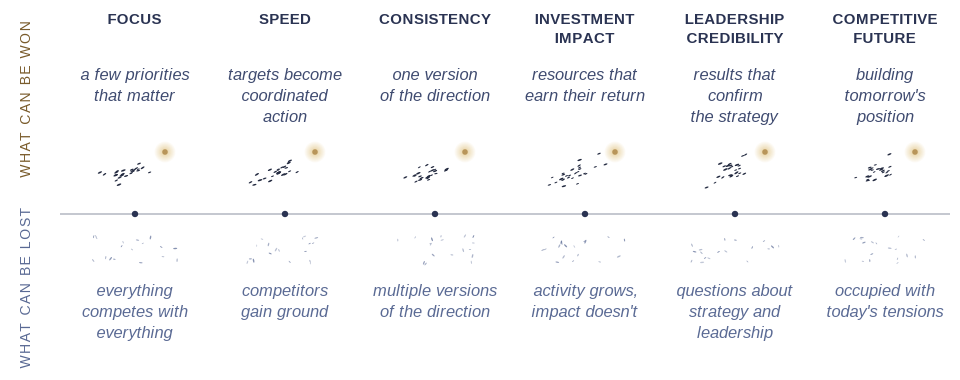
Yet the decisive question remains virulent: Are we focused, fast and consistent enough to turn the set direction into competitive advantage?
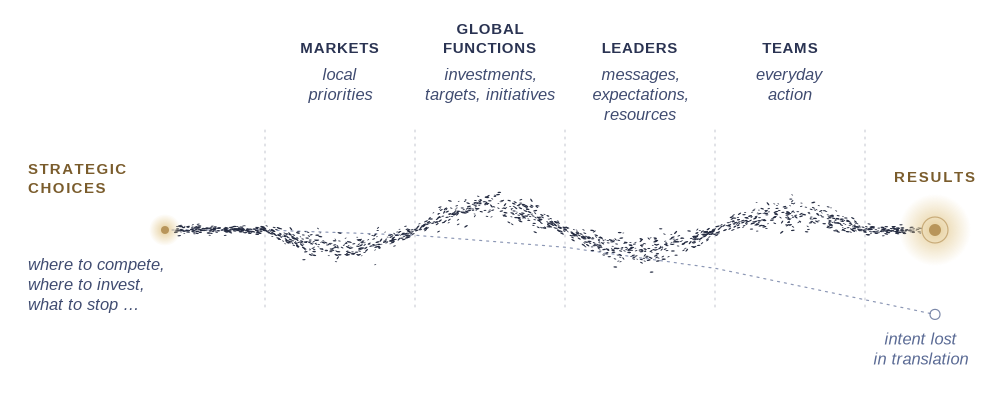
Strategic direction meets multiple organizational realities.
The organization does not receive strategy as a single, unaltered message. Leaders and teams interpret it from within their own realities:
- Sales considers customers, revenue opportunities and commercial urgency.
- Operations considers capacity, reliability and delivery.
- Finance considers returns, risk and the discipline of resource allocation.
- Research and development considers technological possibilities, dependencies and time horizons.
- Markets consider local customers, competitors and regulatory conditions.
- Corporate functions consider enterprise-wide coherence, efficiency and control.
These perspectives are legitimate. But they can lead to different conclusions about priorities, resource allocation and acceptable trade-offs.
The challenge is to connect domain-specific intelligence with the strategic direction of the whole.
» Leadership needs to synchronize and integrate multiple realities for enterprise performance.
»
Build-in tensions that improve strategy differ from conflicting interests that weaken its force.
What leadership teams notice.
Issues rarely appear as complete failure of execution. Business continues to operate, targets are tracked and initiatives move forward. Management-reviews take place. People work hard.
Yet leadership may begin to notice signs such as:
“Why do we invest
in multiple priorities without seeing
enough impact?”
“Why do we continue
to add initiatives
instead of making clearer choices?”
“Why do some teams
move quickly while others struggle
to gain traction?”
“Why do decisions that appeared clear at the top loss clarity as
they move through
the ranks?”
“Why does the set direction result in different priorities across markets and functions?”
“Why do scorecards show activity without
giving us sufficient confidence in real progress?”
“Why are tactical demands repeatedly displacing the work
on our longer-term
game plan?”
“Why do efforts taken still lack results at the speed the business requires?”
Individually, these observations may appear manageable. Taken together, they might indicate that the teams generate considerable activity without creating enough collective business impact.
- The issue is not necessarily a lack of commitment. It may be a lack of collective focus on the choices that matter most.
The leadership challenge:
Strategy is built here and now without becoming trapped by today.
One of the most difficult executive tensions lies between tactical responsiveness and strategic consistency.
Leadership cannot ignore immediate realities. Customers require decisions, performance gaps require action, operational disruptions demand attention, competitors create pressure, investors and supervisory bodies expect results.
At the same time, the organization cannot allow every short-term demand to redefine its longer-term direction.
If leadership responds only to current urgency, strategy becomes little more than a collection of changing priorities. If leadership adheres rigidly to an earlier plan, the organization may fail to respond to new realities.
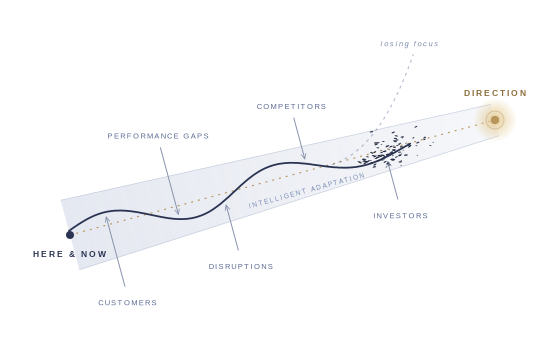
The task is therefore to maintain sufficient continuity of direction while learning and adjusting along the way. Leadership must repeatedly ask:
- Which developments require a tactical response?
- Which trends challenge our strategic assumptions?
- Which priorities must remain protected despite short-term pressure?
- Which choices should be adjusted because reality has changed?
- Where are we adapting intelligently?
- Where are we simply losing focus?
Strategic leadership means holding this tension without allowing
either short-term pressure or long-term ambition to dominate blindly.
What is at stake:
Direction results in implications reaching beyond the delivery of strategic initiatives. They affect the organization’s ability to turn strategic choices into competitive and financial results.
Our support in this situation.
Pending on the clients' specific challenge, typically the first question may be: “Where do choices taken foster focus and impact, and where do they loose transformational power as they move through the organization?”
Together with leadership, we identify a feasible number of strategic choices. These may concern:
» We clarify, what the organization is trying to achieve and why it matters now.
» We seek to understand how achievements would support performance and value-creation.
» We then follow these strategic choices into the organization.
This may involve focused conversations with the extended leadership team and selected experts responsible for turning the choices taken into decisions, priorities and results.
Questions may include:
- How do different leaders describe the strategic choice?
- What has each function, market or business unit made of it?
- Which decisions have reinforced the chosen direction?
- Which decisions have unintentionally weakened it?
- Which initiatives compete for the same resources and attention?
- What can be learned from the areas that are moving more effectively?
- Which assumptions should leadership now confirm, challenge or adjust?
- Which activities should be protected, changed or stopped?
»
This is not about reviewing the entire strategy or diagnosing the whole organization. The purpose is to make the path from strategic choice to business impact sufficiently visible.
What leadership teams seek to achieve.
In an organization capable of translating a set direction into focused action, measurable impact and timely learning, leadership typically seeks to become better able to:
At its best, leadership enables the organization to remain:
» focused without becoming rigid,
» adaptive without becoming erratic,
» ambitious without loosing sight of operational reality.
Business impact by discipline and adaptation.
A top in its class organization uses strategy to guide choices while continuing to learn from customers, markets, competitors and its own experience.
This requires discipline.
The discipline to protect important priorities, to resolve trade-offs to stop activities that dilute attention. The discipline to hold leaders accountable for the whole, not only for their own areas.
It also requires adaptability.
The willingness to challenge assumptions and ability to recognize material changes early. Judgment to distinguish between temporary disruption and a genuine shift in strategic reality. It asks for courage to adjust direction when adjustment is necessary.
The leadership teams task is to help the organization remain strategically coherent while continuously engaging with a changing world. That is how strategic choices become lasting business impact.
Are your strategic choices creating the expected impact?
Strategy does not need to be wrong for its impact to remain below expectations. The issue may lie in focus, speed, consistency, competing priorities or the organization’s ability to learn and adjust.
Sometimes a focused conversation is enough to identify where strategic direction is gaining force, where it is losing it and which question deserves leadership attention first.w
If your organization is working hard but not yet creating the business impact its strategic choices should produce, let’s start with a conversation.