Four questions leadership teams eventually face.
Leadership teams rarely struggle because information is missing. More often, they struggle because important decisions must be made before certainty exists: markets shift, competitors adapt fast, technologies evolve organizations grow while entering new territories.
People interpret perceived realities in different ways. Yet leadership teams are still expected to provide direction, create progress and deliver results.
Familiar with the ways of working in systemic consulting, mitomo refers to four perspectives that help leadership teams to look at the challenges at hand from various ends situations. They do not provide ready-made answers. Instead they help leaders ask better questions.
Why progress gains force in some situations and stagnates in others?
The Circle of Progression
Most leadership teams do not struggle because they lack ambition. They know what they want to achieve and why it matters. Resources have been committed. People have been informed. Initiatives have been launched.
Yet some ambitions create lasting progress while others never seem to move beyond activity.
The question is: Why?
- Why do some strategies create visible movement while others remain trapped in meetings, presentations and implementation plans?
- Why do some transformations begin to reinforce themselves while others require constant executive intervention?
- Why do some organizations create participation, ownership and momentum while others continue pushing without generating real traction?
These questions sit at the heart of the Circle of Progression. A different way of looking at progress. Most organizations perceive progress as a sequence of project steps: a plan has been developed and activities have been launched. Milestones have been achieved. Results are in place. The project is completed.
The Circle of Progression looks at a different reality. It starts from the observation that organizations are social systems: People interpret and respond. People influence one another. People create meaning. Progress therefore rarely develops in a straight line. Instead, it emerges through a series of reinforcing transitions.
The Circle of Progression describes these transitions as: turning Mission into motion, momentum and Movement.
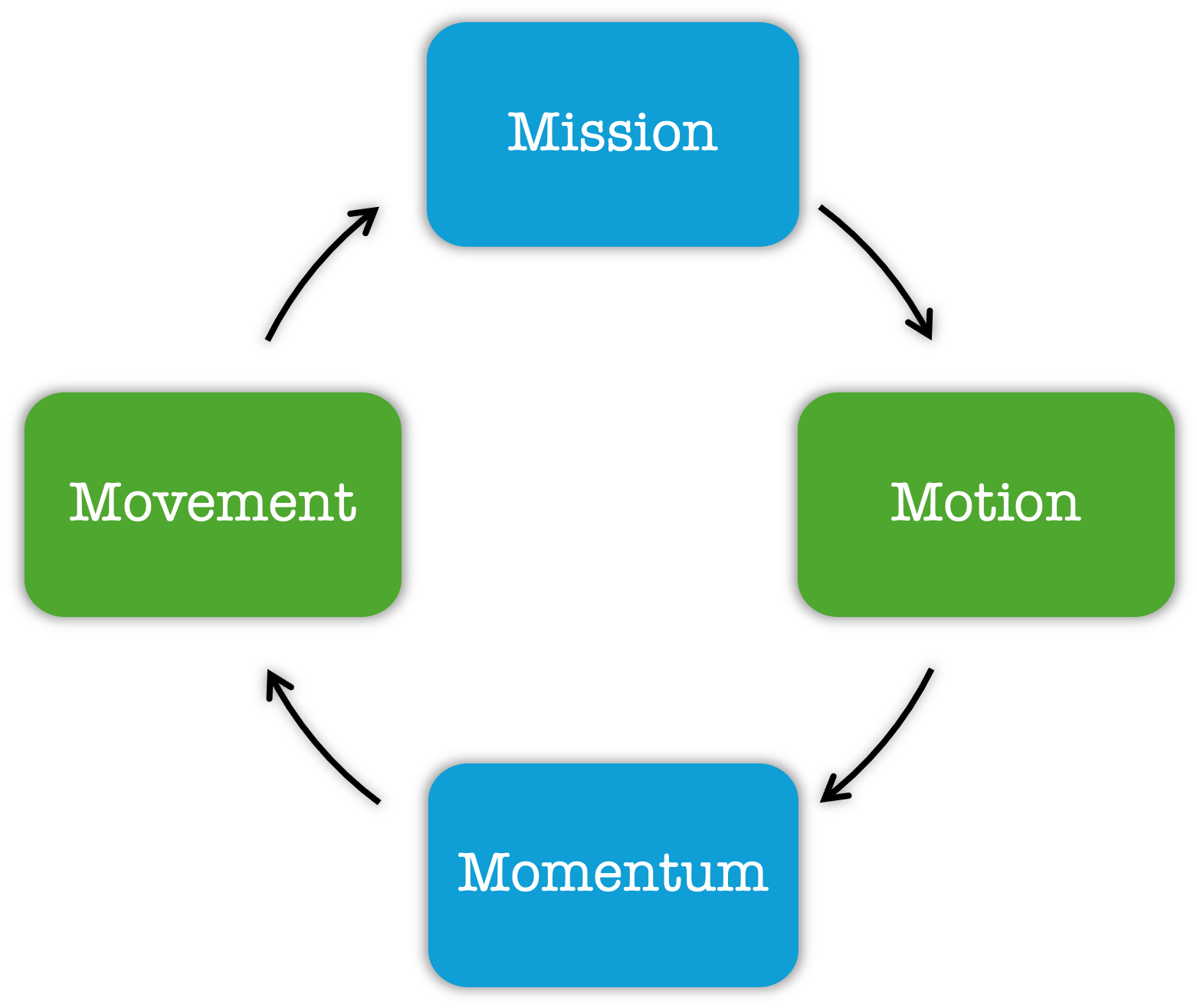
The most important insight is this: these are not static stages. Organizations continuously oscilate between them. The greatest potential for acceleration lies not within the phases themselves but within the transitions between them.
Mission
Everything begins with a mission. Not necessarily a formal purpose statement or a strategy document. A mission exists when people share a meaningful sense of direction. They understand: what matters, why it matters, and what future they are trying to create.
But orientation alone changes very little. Many organizations possess convincing strategies and inspiring missions. Yet little happens afterwards. The mission remains intellectually understood but operationally inactive.
A leadership team may therefore ask: Are people aligned around a direction? Or are they merely familiar with it? Do people subscribe to it, prioritize and own it?
Motion
Motion Is direction turned into visible action. Choices are made. People invest effort. Priorities start influencing behavior. At this stage organizations often feel significantly busier. But activity alone is not proof of progress. Many initiatives become trapped in hyper-activism.
Leaders face a multitude of meetings, plans, programs and reporting structures. Yet results remain difficult to identify. Motion without progression can create a dangerous illusion: something seems to be happening. Yet very little is actually changing.
The leadership challenge is not generating mindless action. Leadership is asked to invest into mindful effort that creates traction.
Momentum
Momentum emerges when actions begin reinforcing one another. People start seeing evidence that progress is possible. Success becomes visible. Confidence grows. Participation increases. The organization no longer relies exclusively on leadership attention to sustain activity. Energy begins to circulate through the system itself. This phase often represents a turning point.
Many organizations work hard for years without reaching it. Others reach it unexpectedly and then struggle to sustain it. The crucial question becomes: What is the source for energy and reinforcement? And how can we strengthen it?
Organizations frequently misunderstand momentum. They assume momentum is enthusiasm.
It is not. Momentum is reinforcement. Actions create results. Results strengthen commitment. Commitment generates further action. The cycle begins accelerating.
Movement
At some point something changes. The initiative, organization, strategy or transformation ceases to depend entirely on its original leaders. People begin carrying it themselves. They contribute new ideas and create local adaptations. They recruit others. They strengthen the mission through participation. This is where momentum evolves into movement.
Movement does not imply loss of leadership. But it does require leaders to accept that participation creates variation. Something larger than the original plan begins to emerge. The challenge becomes: Can leadership maintain direction while allowing ownership to spread?
This is often where organizations become cautious. Increased participation can feel less predictable. Leaders may respond by increasing control. Ironically, this frequently weakens the very movement they helped create.
Where progress typically breaks down
The Circle of Progression does not only highlight acceleration. It also reveals common failure patterns.
Mission → Motion
Failure: Over-idealization.
What leaders often observe:
A compelling narrative. Strong intentions. Widespread agreement. Very little action. People support the idea. Nobody translates it into reality.
Motion → Momentum
Failure: Over-control.
What leaders often observe:
Significant effort. Limited traction. People are active but not energized. Everything depends on continued management attention. The organization is moving. But progress does not feel self-reinforcing.
Momentum → Movement
Failure: Fear of losing control
What leaders often observe: Participation expands. Leadership becomes cautious. Experimentation slows. Ideas require excessive approval. Ownership weakens because people feel constrained.
Movement → Mission
Failure: Nostalgia or rigidity
What leaders often observe: An organization becomes attached to previous success. The mission stops evolving. Relevance declines. People protect the past rather than renewing the future.
Why this perspective matters
Many leadership teams focus on: strategy, structures, governance, initiatives. All of these matter. Yet the Circle of Progression asks a different question:
How does progress actually emerge? Not in theory, nor in PowerPoint or in governance documents.
But in the lived reality of organizations. The perspective helps leadership teams understand:
- why some initiatives gain force while others lose energy
- why activity does not always create momentum
- why ownership sometimes spreads and sometimes does not
- why organizations become trapped despite good intentions
- why movements occasionally emerge where leaders least expect them
Most importantly, it helps leaders distinguish between: activity and progress, attention and commitment, participation and ownership. Because those distinctions often determine whether an ambition becomes a reality or remains an aspiration.

Taylor Swift:
How does an audience become a movement?
Most organizations have customers. Many organizations have followers. Some organizations build communities. Very few create movements.
Viewed through the lens of the Circle of Progression, the most interesting aspect of Taylor Swift's development is not commercial success, popularity or celebrity status. It is the gradual transformation of a personal artistic mission into a self-reinforcing global movement supported by millions of active participants.
For leadership teams, this raises a relevant question: What allows people to move beyond passive support and become active contributors to something larger than themselves?
Mission
Every movement begins with a mission. Not a slogan. Not a marketing message. A meaningful proposition that gives people a reason to care. Taylor Swift's mission was remarkably clear from the beginning. Long before global success, she consistently positioned herself around a simple idea:
Authentic storytelling based on personal experience, emotional honesty and creative ownership.
The message was easy to understand. More importantly, it was easy to recognize. Different albums evolved. Different musical styles emerged. The mission remained identifiable.
For leadership teams this is a critical observation. Many organizations continuously change messages, priorities and narratives. As a result, people struggle to identify what actually remains constant.
Taylor's mission became a stable reference point. People knew what they were engaging with.
The leadership question: Does our organization have a mission that people can recognize consistently over time?
Motion
A mission does not create progress by itself. Progress begins when the mission becomes visible through action. This is where many organizations become trapped. Leaders communicate direction. Present strategies. Launch initiatives. Yet little meaningful movement follows.
Taylor Swift avoided this trap through relentless motion. Album after album. Tour after tour. Continuous experimentation, engagement and learning. The mission remained stable while the expression evolved. The important insight is that motion was not driven by occasional campaigns.
It was sustained through repeated action.
For leadership teams this creates another useful distinction: There is a difference between communicating ambition and creating visible progress. Motion emerges when people can see commitment translated into action.
The leadership question: Where is our mission becoming visible through consistent action rather than communication alone?
Momentum
Momentum emerges when actions begin reinforcing one another. At this point something qualitatively different began to happen. Fans no longer simply listened. They discussed. Interpreted. Shared. Created. Amplified. Attention stopped flowing in only one direction. The audience began returning energy into the system.
This is what makes momentum so powerful. Leadership no longer supplies all of the energy. The system begins generating energy itself. Many organizations never reach this stage. They continue pushing.Communicating. Motivating. Explaining. Without generating self-reinforcing momentum.
The most important lesson from Taylor Swift's development may be this: Momentum was not created by greater control. Momentum emerged through increasing participation.
The leadership question: Where are people actively strengthening what we are trying to achieve rather than simply responding to it?
Movement
Movement begins when participation creates something larger than the original initiative.
This is where the Taylor Swift example becomes particularly interesting for CEOs. At some point the community became more than a fan base. Shared rituals and symbols emerged. Shared language and
interpretations emerged. People increasingly connected not only to Taylor Swift but also to one another. The resulting community became capable of sustaining attention, generating meaning and attracting new participants independently. The movement developed a degree of self-sustaining force.
For many leadership teams this represents a difficult transition. Because movement requires a different type of leadership. As participation grows, predictability decreases. People contribute their own ideas. Adapt the mission. Extend the original narrative. Control inevitably becomes more difficult.
Many organizations respond by increasing governance and reducing participation. Ironically, that often weakens the very thing they are trying to strengthen. The Taylor Swift example suggests a different lesson: Movements grow when leadership provides direction without controlling every expression of participation.
The leadership question: Are we creating followers of our direction, or are we creating contributors who carry it forward?
Looking through the lens of the
Failure Modes the Circle of Progression also highlights where progress often breaks down. The Taylor Swift example becomes particularly powerful because it successfully navigated several transitions that frequently derail organizations.
Mission → Motion
Many organizations suffer from over-idealization.
The story is compelling.
The action never follows.
Taylor Swift avoided this trap through continuous output and sustained effort over many years.
The mission consistently translated into visible action.
Motion → Momentum
Many organizations become trapped in over-control.
People work hard.
Activities increase.
Traction remains limited.
Taylor Swift's development moved beyond this pattern because participation was encouraged rather than tightly managed.
The audience became involved in generating meaning.
Momentum → Movement
Many leaders become uncomfortable when ownership begins spreading.
Participation increases.
Control decreases.
Momentum often stalls.
The Taylor Swift community continued expanding because participation itself became part of the value proposition.
The growth of the movement was not treated as a threat.
It became a source of strength.
Movement → Mission
Successful movements eventually face a different risk. Nostalgia. Rigidity. Attachment to former success.
Taylor Swift repeatedly reintegrated new experiences, new formats and new interpretations into the broader mission.
The mission remained recognizable while continuing to evolve.
What leadership teams can learn
This example is ultimately not about music. It is about a challenge many leadership teams face. How do we create enough participation, ownership and reinforcement for progress to become self-sustaining?
The Circle of Progression suggests that sustainable movement is not created through communication alone. Nor through strategy alone. Nor through control alone. It emerges when:
- a mission provides meaningful direction,
- action consistently reinforces the mission,
- participation creates momentum,
- ownership spreads,
- and leadership remains willing to trade some control for greater collective contribution.
Perhaps the most important question for any leadership team is therefore: What would need to happen for the people around us to stop consuming our ambition and start carrying it forward themselves?
Transparency International:
How does personal conviction become distributed impact?
Most leadership teams eventually encounter the same challenge. An important initiative starts with a small group of highly committed people. Energy is high. Direction is clear. Decisions are made quickly. Progress becomes visible.
Yet a critical question emerges: What happens when the initiative becomes larger than the people who started it? Can momentum continue to grow? Can ownership spread? Can impact scale beyond the direct reach of the original leaders?
Viewed through the lens of the Circle of Progression, the development of Transparency International offers a compelling perspective on these questions. What began as a shared conviction among a small group of individuals gradually evolved into a globally distributed movement operating across countries, institutions and political systems.
For leadership teams, this raises an important question: How do we build something that remains effective when it no longer depends on the constant attention of its founders?
Mission
Every movement begins with a mission. Not simply an objective. Not a project plan. A deeply held conviction that something important must change. For Transparency International, the mission emerged from a growing belief that corruption was not an unavoidable reality.
It was a systemic problem that undermined development, democracy, public trust and human dignity.
The mission gave people a clear point of orientation: Corruption should be made visible. It should be measured and corruption should be challenged. This clarity mattered. Because people rarely commit to vague ambitions. They commit to causes they understand.
For leadership teams, this highlights a familiar challenge. Many organizations communicate strategic priorities. Far fewer create a level of clarity that enables people to understand why a direction truly matters.
The leadership question, Is our mission sufficiently clear for people to understand what they are being asked to support?
Motion
Mission alone changes little. Progress begins when conviction becomes action. Transparency International began translating its mission into structures, tools, partnerships and local chapters. The most interesting aspect of this phase is not organizational growth. It is the creation of mechanisms that allowed the mission to become visible and actionable.
One particularly important example was the development of the Corruption Perceptions Index.
Until then, corruption was often discussed as a general concern. The CPI transformed it into something that could be observed, debated and compared. The mission became actionable because people could now point to evidence rather than aspiration alone.
This is highly relevant for CEOs. Many strategic initiatives fail because the organization cannot see whether progress is actually occurring. People talk about change. But they struggle to observe it.
Motion accelerates when important priorities become visible.
The leadership question How visible is progress becoming inside our organization?
Momentum
Momentum emerges when actions begin reinforcing one another. For Transparency International, this happened when multiple elements started supporting each other simultaneously. Research created credibility. Credibility created attention. Attention attracted partners. Partners increased influence.
Influence created further opportunities for action.
At this stage the organization became far more than a small group of committed founders.
People in different countries started contributing because they saw value in the mission and could identify practical ways to support it.
This is one of the most important observations for leadership teams. Momentum rarely emerges because leaders communicate more frequently. Momentum emerges when people experience evidence that their contribution matters. Progress becomes self-reinforcing when participation generates visible results.
The leadership question What evidence do people see that their efforts are actually making a difference?
Movement
Movement begins when ownership spreads. This is where many organizations struggle. Leaders often want participation. But they remain uncomfortable with the consequences. Because wider participation inevitably creates greater variation. Different interpretations emerge. New ideas emerge.
Local adaptations emerge. Control becomes more difficult.
Transparency International became influential precisely because it allowed ownership to become distributed. National chapters operated within different political, cultural and institutional realities.
Yet they remained connected by a shared mission and a common point of reference. The organization became larger than its founders because responsibility became larger than its founders.
For leadership teams, this may be the most important insight of all. Many strategic initiatives remain dependent on executive attention. Transparency International illustrates a different pattern. Progress became sustainable because ownership became distributed.
The leadership question: Which of our most important priorities would continue to progress if executive attention shifted elsewhere?
Looking through the lens of the Failure Modes the Circle of Progression highlights several risks that frequently prevent movements from developing. The Transparency International example is particularly interesting because it navigated many of these transitions successfully.
Mission → Motion
Failure: Over-idealization
Many organizations create compelling visions. Far fewer create practical mechanisms that enable action.
Transparency International translated conviction into institutions, tools and measurable reference points.
The mission became actionable.
Leadership reflection: Where are we relying on inspiration when we should be creating practical pathways for action?
Motion → Momentum
Failure: Over-control
Many initiatives become trapped in administrative activity. Progress depends entirely on leadership intervention.
Transparency International generated momentum because local actors could contribute meaningfully within a shared framework.
Leadership reflection: Are we creating participation or dependency?
Momentum → Movement
Failure: Fear of losing control
Many organizations become cautious precisely when ownership begins to spread.
Transparency International achieved scale because local chapters retained the ability to act, learn and adapt.
The movement expanded without requiring centralized control of every action.
Leadership reflection: What would happen if we trusted others to carry more of the mission forward?
Movement → Mission
Failure: Nostalgia or rigidity
Long-lasting organizations often become attached to their historical success.
Transparency International continued evolving its mission by addressing new forms of corruption, digital governance and global accountability challenges. The mission remained recognizable while adapting to new realities.
Leadership reflection: Are we protecting the mission or merely protecting its historical form?
What leadership teams can learn
This example is not ultimately about corruption. It is about a challenge many leadership teams face.
How do we create impact that scales beyond the founders, the executive team or a small group of highly committed individuals?
The Circle of Progression suggests that sustained impact emerges when:
- a mission provides clear direction,
- action makes the mission visible,
- progress creates reinforcement,
- ownership becomes distributed,
- and leadership remains willing to trade some control for broader participation.
Perhaps the most relevant question for any CEO is therefore: What would need to happen for our most important initiatives to become stronger because more people carry them, rather than weaker because leadership is no longer pushing them forward?
Barbour:
How do you remain relevant without abandoning your identity?
Most leadership teams eventually face a difficult tension. The business is successful. Customers trust the brand. Capabilities are established. People know what the organization stands for. Yet success rarely protects an organization from change. Markets evolve. Customer expectations shift. Technology creates new possibilities. New competitors emerge.
What made an organization successful yesterday may not be sufficient tomorrow. This creates a challenge that many leadership teams know well: How do we adapt without becoming something else? How do we remain relevant without abandoning the identity that made us successful in the first place?
Viewed through the lens of the Circle of Progression, the development of Barbour offers a compelling perspective on this challenge. For more than a century, the company has navigated successive waves of change while remaining recognizable to customers, employees and partners. The most interesting aspect of the story is not longevity. The more interesting question is: Why did relevance survive when so many competitors, brands and business models disappeared?
For leadership teams, Barbour raises a question that extends far beyond the fashion industry: How do we evolve without losing ourselves?
Mission
Every enduring organization begins with a recognizable mission. For Barbour, the mission was surprisingly simple: Create durable, weather-resistant clothing for people operating in demanding conditions. The mission was not built around fashion. It was built around utility. Protection. Reliability. Longevity. Repairability. That distinction matters.
Because it gave the organization a remarkably stable point of orientation for more than a century.
Many organizations continuously redefine themselves as environments change. Barbour repeatedly adapted the business without changing the underlying promise. This created consistency. Customers understood what the organization stood for. Employees understood what mattered. Strategic decisions could be evaluated against a recognizable identity.
The leadership question Which aspects of our identity should remain recognizable, regardless of how much our business changes?
Motion
Identity creates little value until it becomes visible through action. What makes Barbour interesting is that the company invested continuously in capabilities that reinforced its mission. The most obvious example is waxed cotton. For decades, waxed cotton remained one of the defining characteristics of the product portfolio. At various points, it would almost certainly have been easier to abandon this distinctive capability and follow changing industry trends.
The company chose a different path. Rather than abandoning its strengths, it kept improving and modernizing them. A second example is repairability. Most fashion brands optimize for replacement. Barbour preserved repair and rewaxing as part of its operating model. The company continued investing in capabilities that allowed customers to extend the life of existing products rather than simply purchasing new ones.
From a purely short-term perspective, this appears counterintuitive. From a mission perspective, it is entirely logical. The organization repeatedly translated its mission into operational choices. That consistency reinforced credibility.
The leadership question: Where do our capabilities strengthen our identity? And where are they slowly pulling us away from it?
Momentum
Momentum emerged when Barbour's original strengths gained relevance beyond the markets in which they were created. This is where the story becomes particularly interesting. The company initially served practical outdoor needs. Fishermen. Farmers. Outdoor workers. Yet over time, customers began seeing value that extended beyond functionality. Durability became authenticity. Repairability became craftsmanship. Longevity became quality. The products acquired symbolic value in addition to practical value.
What makes this important for CEOs is that Barbour did not create momentum through reinvention.
The organization created momentum through reinterpretation. The original strengths remained. The meaning attached to those strengths evolved. This is a critical distinction. Many organizations assume competitiveness requires replacing existing strengths. Barbour suggests another possibility.
Sometimes the challenge is helping customers see existing strengths through a new lens.
The leadership question Which strengths do we already possess that may become strategically more valuable in the future rather than less?
Movement
The most interesting leadership lesson emerges in the transition from momentum to movement.
Barbour gradually became associated with values extending far beyond apparel. Durability. Stewardship. Repair rather than replacement. Longevity rather than disposability. Responsible ownership.
The company's rewax and repair services became particularly important here. What began as a practical service gradually reinforced a broader narrative. An old jacket was no longer viewed as a product reaching the end of its life. It became something worth maintaining. Worth repairing. Worth preserving.
That shift reflects something many leadership teams struggle with. The organization allowed the meaning of its mission to evolve. The original mission remained recognizable. Its relevance expanded.
As sustainability became increasingly important to customers, Barbour discovered that values embedded in its history had acquired new significance. The organization remained connected to its heritage without becoming trapped by it.
The leadership question: Are we protecting our mission? Or are we protecting only the way our mission happened to be expressed in the past?
Looking through the lens of the Failure Modes, one reason the Barbour story remains valuable is that it illustrates several failure patterns that successful organizations often face.
Mission → Motion
Failure: Over-idealization
Many companies communicate admirable values that remain disconnected from daily operations.
Barbour repeatedly connected mission and capability. The promise remained visible.
Leadership reflection: Which aspects of our mission are currently visible in operational reality?
Motion → Momentum
Failure: Over-control
Many organizations protect existing business models so aggressively that they fail to recognize new relevance.
Barbour continued expanding products, channels and customer segments without abandoning its distinctive capabilities.
Leadership reflection: Are we protecting strengths or defending habits?
Momentum → Movement
Failure: Fear of losing control
Growth often creates anxiety.
Leaders worry that adaptation will dilute identity.
Barbour repeatedly demonstrated that evolution and identity are not necessarily opposing forces.
Leadership reflection: Which changes would actually strengthen our identity rather than weaken it?
Movement → Mission
Failure: Nostalgia or Rigidity
This may be the greatest danger facing successful organizations. Past success becomes too influential.
The organization preserves familiar forms rather than renewing underlying purpose.
Barbour repeatedly reinterpreted ideas such as durability, craftsmanship and repairability for new generations and new societal concerns. The mission remained recognizable. Its meaning evolved.
Leadership reflection: Are we preserving what matters? Or are we preserving what happened to work yesterday?
What leadership teams can learn
This example is not ultimately about fashion. It is about one of the most fundamental leadership challenges in business. How do successful organizations remain relevant while the world changes around them?
The Circle of Progression suggests that successful renewal emerges when:
- a mission provides continuity,
- capabilities reinforce identity,
- changing conditions create new relevance,
- people discover fresh meaning in familiar strengths,
- and leadership remains capable of distinguishing between identity and tradition.
Because the two are not the same. Traditions may need to evolve. Products may need to evolve.
Capabilities may need to evolve. Business models may need to evolve. What should remain recognizable is the identity that gives those changes coherence and meaning.
Perhaps the most important question for any leadership team is therefore: How do we remain relevant without abandoning our identity? That question refers to the heart of long-term competitiveness, strategic renewal and enduring organizational relevance.
Progress alone is not enough.
The Circle of Progression helps leadership teams understand how direction becomes action, how action gains momentum and how movement may eventually become self-sustaining.
Yet another question inevitably follows. Many organizations succeed in creating movement. Some succeed in sustaining it. Others gradually lose force despite good intentions, capable people and continuing effort.
This raises a different leadership question: Why do some organizations remain competitive over long periods of time while others slowly lose their ability to accelerate?
Progress helps explain movement. It does not fully explain long-term performance. To understand that challenge, leadership teams must look beyond progress itself and examine the conditions that support sustained competitiveness.
What sustains competitive performance over time?
Success Factors for Competitive Edge
Most organizations do not lose competitiveness overnight. Performance often remains acceptable long after deeper problems have started to emerge. Customers remain. Revenue continues. People stay busy. The organization appears to be functioning.
Yet leadership teams gradually begin to notice signs that something is changing. Strategic priorities take longer to gain traction. Progress becomes harder to sustain. Execution requires increasing intervention. Coordination becomes more difficult. Innovation loses momentum. Organizational energy starts to fragment.
This raises an important leadership question: Why do some organizations remain competitive over long periods of time while others gradually lose their ability to accelerate?
Why this matters? Leadership teams often focus on visible outcomes: Growth, Profitability, Market share, Innovation, Customer satisfaction These indicators matter. But they are usually effects rather than causes.
The deeper question concerns the conditions that make sustained performance possible. Organizations rarely struggle because one critical factor is entirely absent. More often, they struggle because several essential conditions gradually weaken at the same time. Performance may remain stable for a period. Competitiveness does not.
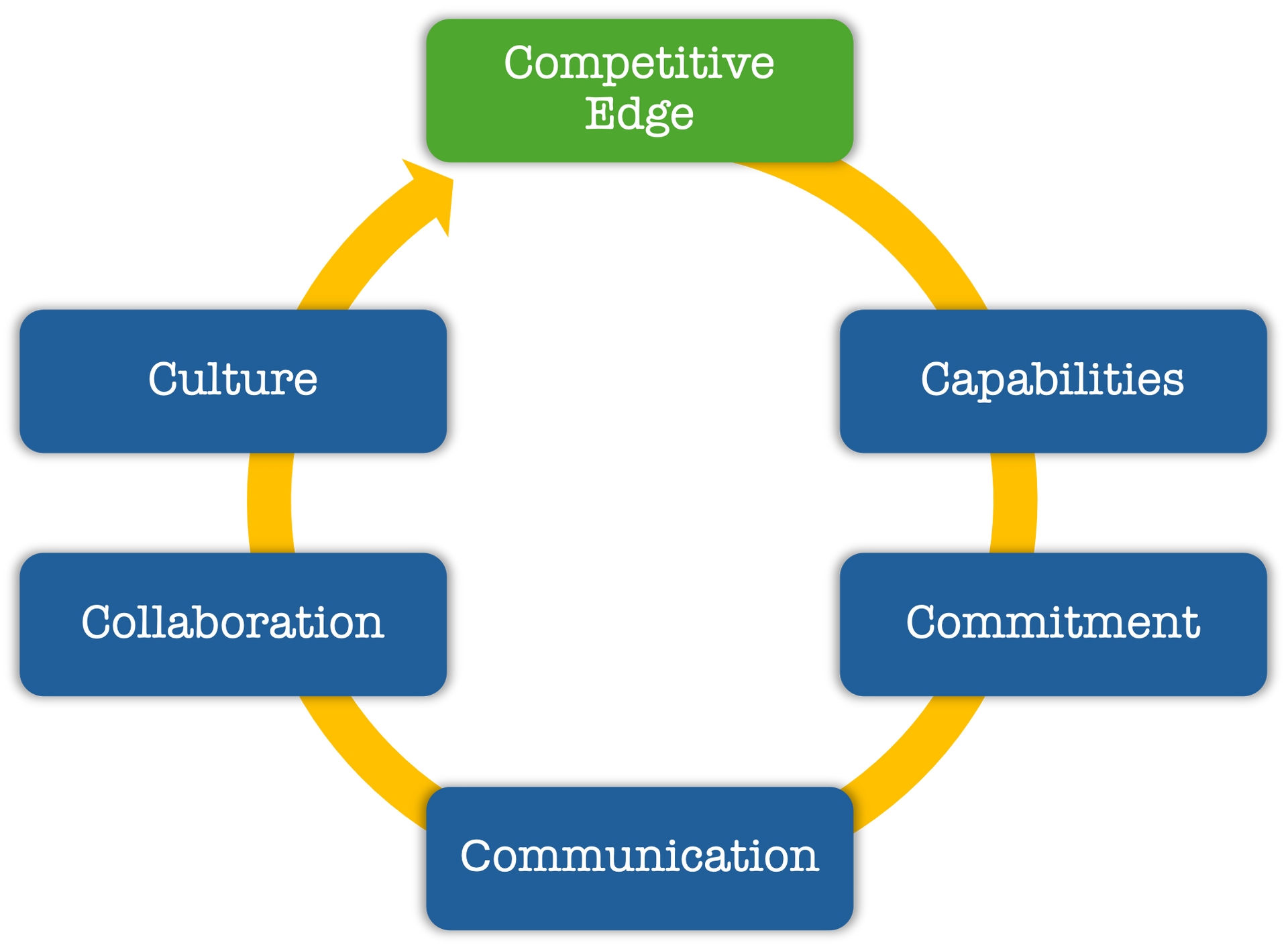
The Success Factors for Competitive Edge focus on five conditions that repeatedly influence an organization's ability to create and sustain movement.
Capabilities
Capabilities enable action. Without the necessary knowledge, skills, systems and resources, even the most compelling ambition remains theoretical. Capabilities answer the question: Can we actually do what we intend to do?
Commitment
Commitment energizes action. People rarely contribute their best effort simply because an initiative exists. Commitment emerges when people understand the direction, believe it matters and choose to invest themselves in it. Commitment answers the question: Do people truly care about the outcome?
Communication
Communication creates alignment. Organizations often underestimate how quickly priorities become fragmented when communication loses clarity. Communication answers the question: Are people interpreting the situation and priorities in a sufficiently consistent way?
Collaboration
Collaboration integrates action. Most organizational challenges cross functional, geographical and hierarchical boundaries. Collaboration answers the question: Can different parts of the organization combine their strengths effectively?
Culture
Culture sustains action. Culture influences what people pay attention to, what they consider acceptable and how decisions are made when nobody is watching. Culture answers the question:
What behaviors does the system consistently reinforce?
This perspective helps leadership teams identify whether progress is slowing because:
- Capabilities are inadequate
- Commitment is weakening
- Communication is fragmented
- Collaboration is difficult
- Culture is unintentionally working against the desired direction
More importantly, it helps leaders recognize that these factors do not operate independently.
Competitive advantage emerges when they reinforce one another. Decline often begins when they stop doing so.
Reflection for leadership teams
- Which of the five factors currently represents our greatest constraint?
- Which factor do we tend to underestimate?
- Where are we compensating for weaknesses rather than addressing them?
- Which reinforcing conditions require attention today if we want to remain competitive tomorrow?
Strong organizations do not succeed on internal strength alone
Capabilities, commitment, communication, collaboration and culture help explain whether an organization can sustain performance over time. But internal strength is only part of the picture.
An organization may have capable people, committed teams and a healthy culture and still struggle to create progress. Its mission may not connect with what matters in the wider environment. Its actions may not appear reasonable under current circumstances. The relevant actors may not be able to work together effectively. Or the structural and cultural conditions may not make sustained movement feasible.
This leads to another leadership question: What is enabling progress, and what is constraining it?
To answer it, leadership teams need to examine not only the organization itself, but also the environment in which mission must become motion, motion must gain momentum and momentum must develop into movement.
What enables progress and what constrains it?
Environmental Forces
Leadership teams spend considerable time defining what the organization should achieve. Strategic direction. Business priorities. Growth ambitions. Transformation agendas. But progress does not depend on intention alone. A mission may be compelling. Actions may have begun. People may be investing significant effort. And progress may still struggle to gain force.
The reason may not lie in the mission or the level of effort. It may lie in the environment in which that mission is expected to develop.
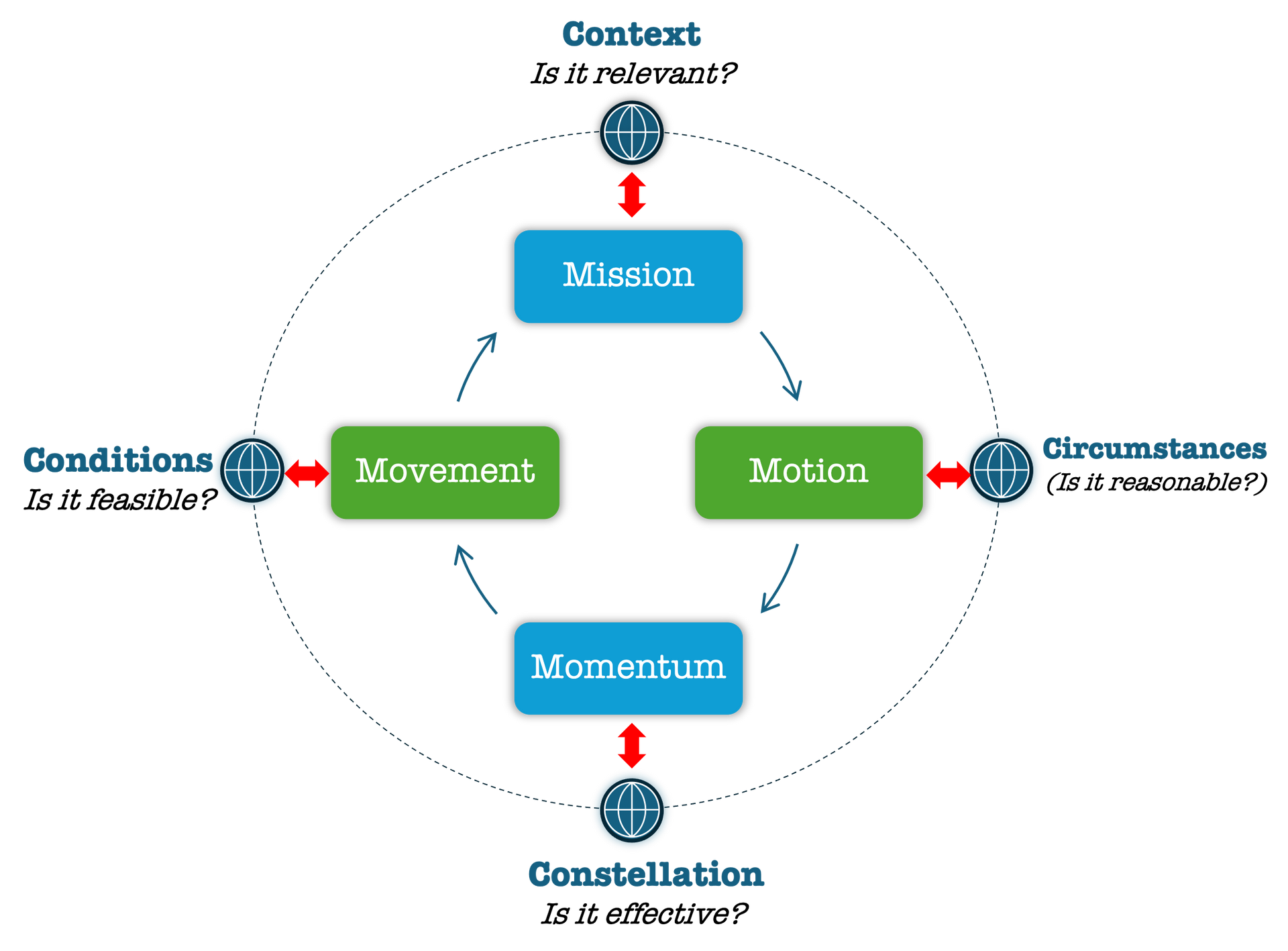
This raises a critical leadership question: What is enabling progress, and what is constraining it? Four questions deserve particular attention: Is the mission relevant within its context? Is action reasonable under the present circumstances? Is the constellation of actors effective? Are the conditions sufficient to make sustained movement feasible? Together, these questions help leadership teams understand why a compelling mission may resonate, stall, accelerate or lose force.
Context
Context describes the broader environment in which a mission emerges. Markets. Industries. Culture.
History. Societal developments. Technological shifts. A mission may be deeply meaningful to the people who created it and still fail to connect with the people it hopes to reach. Relevance emerges when a mission speaks to concerns, aspirations or possibilities that already matter within its environment.
Context therefore asks leadership teams to look beyond their own conviction. Mission always emerges in and against a broader reality.
What this helps leaders see
Context helps leadership teams distinguish between a mission that is internally convincing and one that is externally relevant. It reveals whether the chosen direction connects with developments that customers, employees, partners or society already consider important.
Questions for leadership teams
- Why does this mission matter now?
- Which broader developments strengthen or weaken its relevance?
- What concerns, aspirations or tensions does it address?
- How will history, culture or industry shape its interpretation?
- Would people outside our organization consider it important?
Circumstances
Circumstances describe the immediate situation in which action is expected to begin. Timing. Events. Triggers. Constraints. Opportunities. Pressures. Readiness. A mission may be relevant in principle and still fail to generate motion if acting does not appear reasonable under current circumstances.
People need to understand not only why a direction matters, but why a particular response makes sense now.
Motion is situational. Circumstances determine whether action appears necessary, proportionate and plausible.
What this helps leaders see circumstances help leadership teams distinguish between an ambition that is generally desirable and an action that is reasonable at a particular moment.
They explain why similar initiatives may gain traction in one situation and struggle in another.
Questions for leadership teams
- Why should we act now?
- What has changed?
- Which opportunity or pressure creates urgency?
- Is our proposed response proportionate to the situation?
- Which immediate constraints must we acknowledge?
- How ready is the organization for the next step?
Constellation
Constellation describes the relational configuration through which momentum must develop. Actors. Stakeholders. Networks. Alliances. Trust. Tensions. Influence. Power dynamics.
Momentum does not emerge from plans alone. It emerges through the interaction of people, groups and institutions. The same mission and the same course of action can produce very different outcomes depending on who supports them, who resists them and how the relevant actors relate to one another. A promising initiative may still fail if important stakeholders remain disconnected, critical alliances are missing or unresolved tensions prevent productive cooperation.
What this helps leaders see
Constellation helps leadership teams understand whether the relevant actors are positioned to create collective impact. It draws attention to relationships, dependencies and power dynamics that formal structures may not reveal. The question is not merely whether the right stakeholders have been identified. It is, whether their interaction makes progress more effective.
Questions for leadership teams
- Who must contribute for this initiative to gain momentum?
- Whose trust, support or legitimacy is essential?
- Which relationships currently strengthen progress?
- Which tensions or competing interests weaken it?
- Who connects different parts of the system?
- Which important alliances are still missing?
- Does the current constellation allow different strengths to reinforce one another?
Conditions
Conditions describe the structural, cultural and material foundations required for movement to take root and endure. Resources. Rules. Systems. Infrastructure. Governance. Capabilities. Norms. Culture.
Identity. A mission may be relevant. Action may appear reasonable. The constellation of actors may be promising. And sustained movement may still remain infeasible.
People need the authority, capabilities, time and resources to act consistently. Structures and systems must support rather than contradict the intended direction. Cultural norms and collective identity must make the desired behaviour credible and sustainable. Movements require enabling conditions.
What this helps leaders see
Conditions help leadership teams distinguish between intention and feasibility. They reveal whether the organization possesses the foundations required to sustain progress without permanent executive intervention. Feasibility is not a question of resources alone. It emerges from the interaction of capability, authority, infrastructure, culture and identity.
Questions for leadership teams
- Do people have the capabilities and resources required to move forward?
- Do structures and systems support the chosen direction?
- Which rules or routines are unintentionally slowing progress?
- Does decision-making take place where the necessary knowledge exists?
- Which cultural norms reinforce the intended movement?
- Which established practices pull the organization back?
- Could progress continue without constant leadership pressure?
What these four dimensions help leaders see
Leadership teams often respond to slow progress by increasing communication, adding resources or creating more pressure. Those responses may help. But they address very different problems as though they were the same. The four dimensions enable a more precise assessment:
- Is the mission relevant?
- Is the proposed action reasonable now?
- Is the constellation of actors effective?
- Are the conditions sufficient to make sustained movement feasible?
Each question points towards a different leadership challenge. A relevance problem cannot be solved by adding resources. An unreasonable response cannot be repaired through more communication. An ineffective constellation cannot be corrected through governance alone. And an infeasible movement cannot be sustained indefinitely through commitment and executive pressure.
Progress gains force when relevance, reasonableness, effectiveness and feasibility reinforce one another. That is the leadership value of this perspective: it helps CEOs identify more precisely why progress is gaining force, where it is being constrained and what may require attention next.
People determine whether opportunities become reality.
Environmental Forces help leadership teams understand the conditions surrounding the organization. They reveal opportunities. They reveal constraints. They reveal changes that may strengthen or weaken strategic choices.
Yet no strategy succeeds on environmental conditions alone. Every strategic priority. Every transformation. Every growth initiative. Every change effort. Ultimately depends on people. People interpret the situation. People decide whether to engage. People determine whether momentum grows or fades.
This raises one of the most persistent challenges in leadership: Why do intelligent and committed people respond so differently to the same situation?
Why do people respond differently to the same change?
Fundamental Human Needs
Many leadership teams eventually encounter the same puzzle. The same strategy is communicated. The same change is announced. The same message is delivered. Yet people respond very differently. Some become enthusiastic. Some become cautious. Some actively contribute. Others remain distant.
This raises a leadership question that sits at the heart of every transformation: Why do intelligent and committed people respond so differently to the same situation?
Why this matters? Organizations do not change. People do. Strategies are interpreted. Messages are interpreted. Leadership decisions are interpreted. The same event can be experienced very differently depending on what people perceive to be at stake.
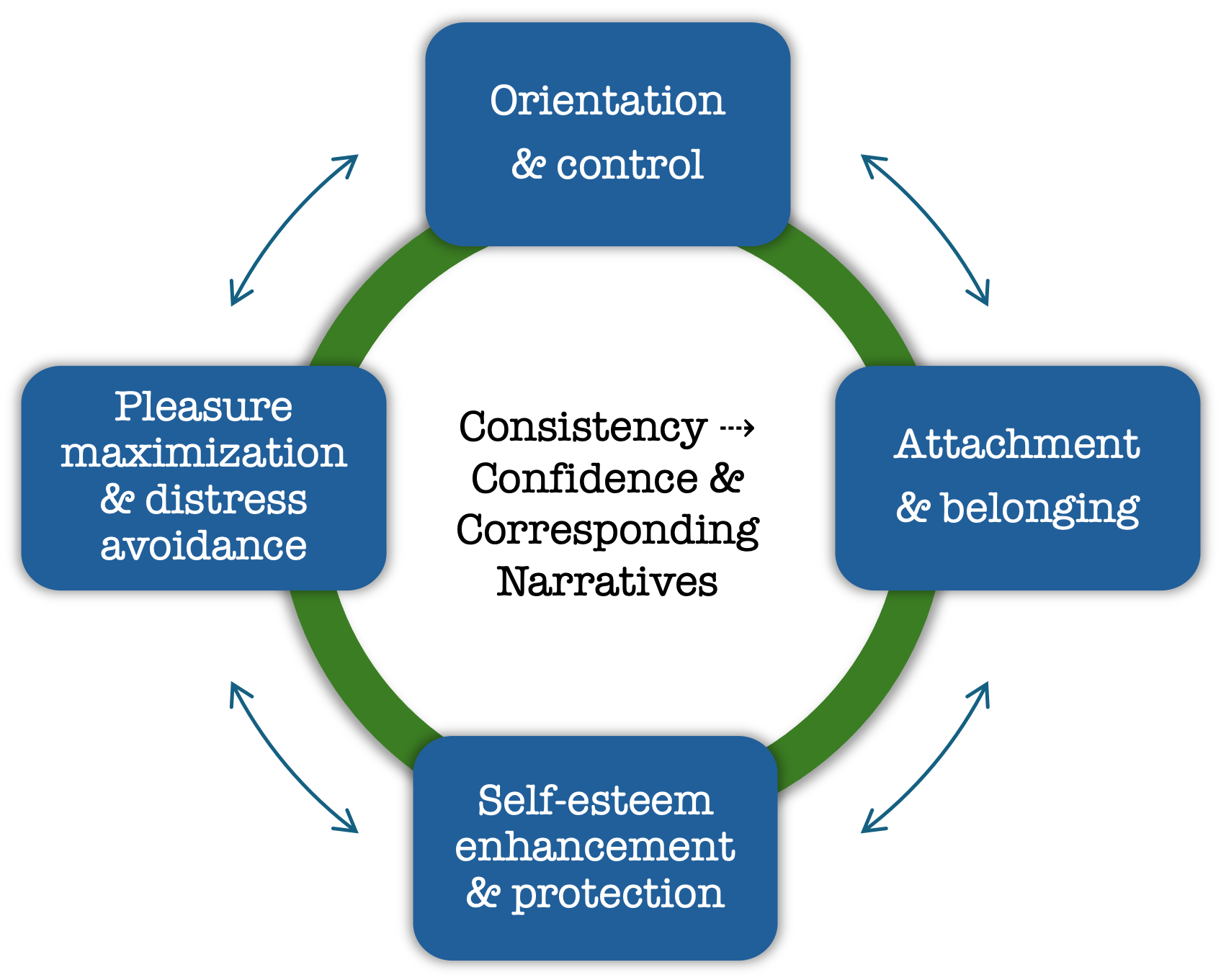
Many change efforts struggle because leaders focus primarily on the logic of change. People often respond to something deeper: their experience of the change. Fundamental Human Needs provide a lens for understanding the drivers of human behaviour.
Orientation and Control
People seek clarity. They want to understand what is happening and how it affects them. Uncertainty creates stress. Orientation reduces it. The question becomes: Do people understand the situation well enough to act confidently?
Belonging and Attachment
People want to feel connected. They want to know they remain part of something important.The question becomes: Do people feel included and connected?
Self-Esteem and Recognition
People want to contribute meaningfully. They want their effort, expertise and experience to matter.
The question becomes: Do people feel valued and respected?
Security and Wellbeing
People seek physical, emotional and economic security. The question becomes: Do people feel safe enough to engage openly?
What this perspective helps leaders see
Leadership teams often interpret resistance as opposition. This perspective encourages a different interpretation. Resistance may signal: Confusion. Disconnection. Loss of status. Uncertainty. Concerns about wellbeing. Understanding these signals helps leaders engage with people more effectively.
Reflection for leadership teams
- What experience are people currently having?
- Which needs are being strengthened?
- Which needs may be feeling threatened?
- What are people protecting?
- What would help them engage more confidently?
Seeing familiar situations through different lenses
Each of the four perspectives highlights a different aspect of organizational reality.
- The Circle of Progression helps explain how movement emerges.
- The Success Factors for Competitive Edge help explain why movement can be sustained.
- Environmental Forces help explain why some opportunities gain traction while others struggle.
- Fundamental Human Needs help explain why people choose to engage, contribute or withdraw.
No single perspective is sufficient on its own. Their value lies in combination. The same situation often reveals very different insights depending on the lens through which it is viewed. The examples that follow demonstrate how these additional perspectives can deepen our understanding of familiar situations.
Taylor Swift through the Success Factors for Competitive Edge
Why does extraordinary success remain sustainable?
Most leadership teams eventually discover that success and sustainability are not the same thing. Many organizations achieve visibility. Many launch successful products. Many attract customers. Far fewer retain relevance over extended periods of time while their environment continuously changes.
Viewed through the lens of the Success Factors for Competitive Edge, the most interesting aspect of Taylor Swift's development is not popularity. It is sustainability. The question is: Why did success continue to accelerate rather than fade?
A closer look suggests that multiple reinforcing conditions evolved simultaneously.
Capabilities
Songwriting, storytelling, performance, audience engagement and continuous reinvention created exceptional creative capabilities. Importantly, these capabilities did not stand still. They evolved with every album, tour and artistic transition.
Commitment
Commitment extended well beyond professional execution. The commitment of audiences increasingly mirrored the commitment of the artist herself. People invested attention, time, energy and emotional connection. The relationship became reciprocal.
Communication
Communication never relied solely on promotion. Narratives, symbols, recurring themes and personal storytelling created strong alignment between creator and audience. People understood what the story stood for and why it mattered.
What leadership teams can learn
Many organizations focus heavily on capability building and underinvest in the conditions that sustain capability. Taylor Swift's development illustrates that long-term competitive advantage rarely emerges from one strength. It emerges when capabilities, commitment, communication and culture reinforce one another over time.
Leadership reflection: Which conditions currently sustain our success?And which conditions are becoming weaker while we are still focused on today's performance?
Transparency International through Environmental Forces
Why did this mission gain traction?
Strong missions exist everywhere. Only some become influential. Viewed through the lens of Environmental Forces, the development of Transparency International raises a different leadership question: Why did this mission gain momentum when it did? The answer lies not only within the organization itself. It lies in the environment surrounding it.
Context
By the early 1990s, questions of governance, development, public accountability and institutional trust had become increasingly important internationally. The mission addressed a growing concern that many people already recognized but struggled to articulate. The context made the mission relevant.
Circumstances
Growing frustration with corruption created urgency. At the same time, international institutions, governments and civil-society actors were searching for practical responses. Action became reasonable because circumstances made inaction increasingly difficult to justify.
Constellation
Transparency International connected a highly effective constellation of actors. Researchers. Policymakers. International institutions. Journalists. Local chapters. Advocates. Momentum emerged because these actors reinforced one another rather than working in isolation.
Conditions
The development of the Corruption Perceptions Index, international governance structures, national chapters and supporting institutions created conditions that allowed the mission to grow beyond its founders. The movement became feasible because the required infrastructure gradually emerged.
What leadership teams can learn
Organizations often assume that a strong mission creates momentum. Transparency International suggests something different. Momentum emerges when relevance, reasonableness, effectiveness and feasibility align.
Leadership reflection. Which environmental forces are currently helping our most important priorities And which forces are quietly constraining them?
Barbour through Fundamental Human Needs
Why do people remain loyal?
Most organizations explain loyalty through products, services, quality or brand strength. Those factors matter. Yet they rarely tell the whole story. Viewed through the lens of Fundamental Human Needs, Barbour becomes interesting for a different reason. The question is: Why do people remain connected to something for decades?
The answer lies partly in the needs that the relationship fulfils.
Orientation and Control
The brand offers predictability in a world characterized by constant change. People know what the organization stands for. The products remain recognizable. The promise remains understandable.
Belonging and Attachment
Barbour has become associated with communities, traditions and shared values. People often feel connected not only to the products themselves but also to what those products symbolize.
Self-Esteem and Recognition
Craftsmanship. Authenticity. Durability. Long-term ownership. For many customers, these characteristics communicate something about personal values and identity.
Security and Wellbeing
Repairability and longevity create reassurance. Customers know the product was designed to last. Trust becomes part of the experience.
What leadership teams can learn
People rarely develop lasting attachment to organizations, brands or communities because of functionality alone. They remain committed when something connects with deeper human needs. The stronger the connection, the more resilient the relationship often becomes.
Leadership reflection: Beyond functionality, what needs are people fulfilling through their relationship with our organization?
What leadership teams repeatedly discover
Across industries, organizations and movements, a number of recurring observations emerge.
People support what they find meaningful.
A compelling mission creates more energy than a compelling task.
Progress accelerates when participation increases.
Movements grow when people become contributors rather than observers.
Competitive advantage is sustained through reinforcing conditions.
Capabilities alone are rarely enough.
Relevance cannot be created through communication alone.
A mission gains force when it connects with something that already matters.
Timing matters.
The same initiative can succeed or struggle depending on circumstances.
Relationships shape outcomes.
Momentum often emerges through networks rather than structures.
Ownership scales impact.
Organizations become stronger when progress no longer depends on a small group of leaders.
Identity can become a strategic asset.
Organizations that understand what should remain stable often adapt more effectively.
Meaning creates loyalty.
People remain committed to what helps them satisfy important human needs.
Better understanding often precedes better decisions.
Leadership teams rarely lack information. More often, they benefit from better ways of seeing.
Comparing three different worlds
At first glance, a global pop star, an international NGO and a heritage fashion brand appear to have little in common. Yet viewed through the perspectives presented on this page, they reveal remarkably similar leadership challenges.
Perspective
Core Leadership Question
Mission
Critical Leadership Challenge
What Created Motion?
What Created Momentum
What Enabled Movement?
Primary Risk
Most Important Environmental Force
Dominant Human Need
Leadership Lesson
Reflection for Leadership Teams
Taylor Swift
How does an audience become a movement?
Authentic storytelling and artistic ownership
Transforming followers into active participants
Consistent creation, experimentation and audience engagement
Shared meaning, rituals, participation and community identity
A community capable of generating meaning independently
Controlling participation too tightly
Digital platforms enabling large-scale participation
Belonging and participation
People support what they help create
Are people carrying our story forward?
Transparency International
How does personal conviction become distributed impact?
Transparency, accountability and the fight against corruption
Transforming founder commitment into distributed ownership
Building chapters, partnerships, advocacy and measurement mechanisms
Reinforcing networks, international legitimacy and local ownership
A globally distributed network capable of acting beyond its founders
Maintaining excessive dependence on founders and central leadership
Growing demand for transparency, governance and accountability
Meaning and contribution
Ownership scales impact
Would progress continue without us?
Barbour
How do you remain relevant without abandoning your identity?
Durability, reliability and long-term value
Transforming heritage into continuous renewal
Continuous investment in products, craftsmanship and repair capabilities
Reinterpreting existing strengths for new customer groups and changing expectations
A mission whose meaning evolved while its identity remained recognizable
Confusing tradition with identity
Rising appreciation for durability, repairability and sustainability
Orientation, continuity and trust
Identity can become a source of renewal
Are we protecting identity or protecting habits?
What becomes visible across all three examples?
Although the contexts differ significantly, the examples point toward a number of common observations. None of them succeeded because of strategy alone. None of them succeeded because of resources alone. None of them succeeded because of leadership intervention alone. Instead, each example reveals a similar progression:
What leaders often focus on
Communication
Direction
Authority
Control
Resources
Structure
Heritage
Activity
➜
➜
➜
➜
➜
➜
➜
➜
What actually creates durable progress
Meaning
Partizipation
Ownership
Contribution
Reinforcing conditions
Relationsships
Renewal
Momentum
Viewed this way, Taylor Swift, Transparency International and Barbour stop being examples from unrelated industries. They become different expressions of a common leadership challenge:
How do we create the conditions under which progress becomes increasingly carried by others rather than continuously pushed by leaders?
That question sits at the heart of strategy execution, organizational transformation, community building and long-term competitiveness.
Concluding remarks
No single perspective explains organizational reality. The value of a perspective lies elsewhere. It helps leadership teams see aspects of reality that might otherwise remain invisible. Sometimes that leads to a different question. Sometimes to a different interpretation. And sometimes to a different decision.
All three can change the trajectory of an organization.